
In the field of personal injury law, “negligence” is the foundational concept that determines who is responsible for an accident. It is not enough to simply be injured; to win a legal case, you must prove that the other party was legally negligent. This is accomplished by establishing the four elements of negligence. If even one of these elements is missing, a claim will likely fail.
1. Duty of Care
The first step in any negligence claim is establishing that the defendant owed the plaintiff a “duty of care.” A duty of care is a legal obligation to act with the same level of caution and prudence that a reasonable person would use in similar circumstances.
In everyday life, these duties are often implied by law or relationship:
- Drivers: Have a duty to follow traffic laws and watch for other motorists and pedestrians.
- Property Owners: Have a duty to keep their premises safe for visitors.
- Doctors: Have a duty to provide treatment that meets the standard of care in the medical community.

2. Breach of Duty
Once a duty of care is established, the next of the elements of negligence is proving that the defendant breached that duty. A breach occurs when the defendant fails to act as a “reasonably prudent person” would have.
Examples of a breach of duty include:
- A driver texting while behind the wheel (breach of duty to stay focused).
- A store owner failing to clean up a spill for several hours (breach of duty to maintain safe premises).
- A manufacturer releasing a product with a known safety defect.
Proving a breach often requires evidence such as witness testimony, video footage, or expert analysis. This is a critical step in most motor vehicle accident claims.
3. Causation
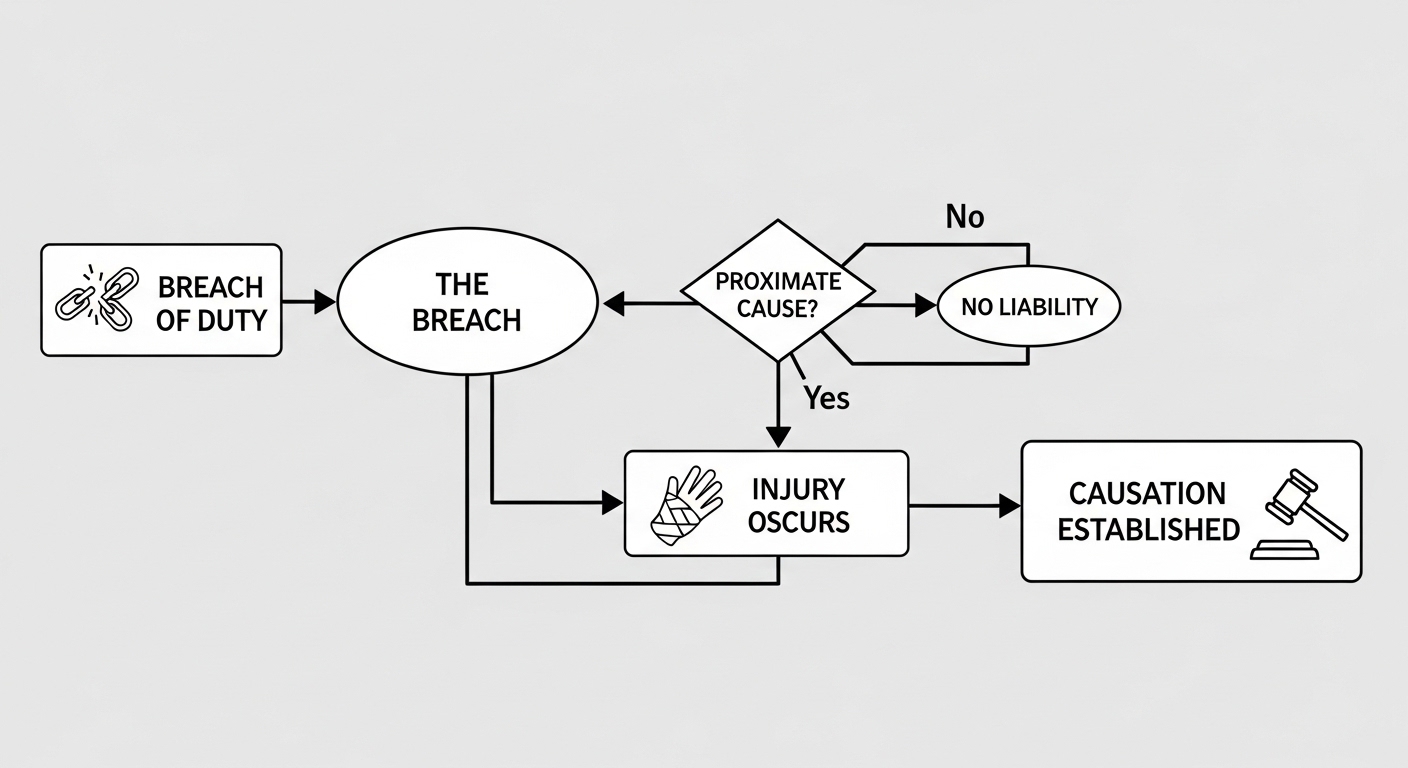
Causation is often the most complex element to prove. It requires showing a direct link between the defendant’s breach of duty and the injuries suffered by the plaintiff. It is divided into two sub-categories:
Actual Cause (Cause-in-Fact)
This uses the “but-for” test: But for the defendant’s actions, would the injury have occurred? If the answer is no, then actual cause is established.
Proximate Cause (Legal Cause)
This relates to “foreseeability.” Was it foreseeable that the defendant’s specific action could cause this type of injury? If a driver runs a red light, it is foreseeable they might hit another car; it may not be foreseeable that a bird startled by the noise would fly three miles away and break someone’s window.
4. Damages
The final element is damages. Even if someone was incredibly negligent, you cannot file a personal injury claim unless you suffered actual harm. The court cannot “punish” someone for a “near miss.”
The plaintiff must show that they suffered a loss that can be compensated by the court. These losses are generally categorized as follows:
- Physical Injuries: Broken bones, soft tissue damage, or traumatic brain injuries.
- Financial Loss: Medical bills and lost wages from missing work.
- Emotional/Mental Harm: Severe anxiety or PTSD resulting from the event.
For a more detailed list of what you can recover, see our post on the Difference Between Economic and Non-Economic Damages.
Summary of the Elements
| Element | Simple Definition |
|---|---|
| Duty | A legal obligation to be careful. |
| Breach | Failure to meet that obligation. |
| Causation | The failure directly caused the harm. |
| Damages | Actual harm or loss occurred. |
Conclusion
Proving the elements of negligence is the core of every personal injury case. By understanding how duty, breach, causation, and damages work together, you can better evaluate the strength of your own legal position. If you are documenting an accident, always look for evidence that supports each of these four pillars.
For more legal definitions and resources, you can explore the Cornell Law School Wex entry on Negligence.